
The ETF creation/ redemption process is the mechanism that enables exchange-traded funds to maintain price efficiency, provide liquidity, and deliver tax advantages. Understanding how this process works and the ecosystem of participants that makes it function helps institutional advisors make better portfolio management decisions and serve clients more effectively.
Understanding the ETF Ecosystem
The ETF creation/ redemption process involves multiple specialized participants working together. Each plays a distinct role in maintaining ETF liquidity and pricing efficiency.
Lead Market Makers and Designated Liquidity Providers
Lead Market Makers and Designated Liquidity Providers are contracted by listing exchanges to provide liquidity for ETFs. They are required to maintain quotes for a specific percentage of the trading day and meet minimum bid-ask spread and depth requirements. Exchanges incentivize tight spreads and deep liquidity through fee rebates.
Secondary Liquidity Providers
These trading firms also make markets in ETFs but do not hold LMM or DLP status. They may receive exchange incentives and contribute to overall market depth.
Authorized Participants
Authorized Participants serve as the middleman between market makers and the ETF for creations and redemptions. They are licensed broker-dealers contracted by the ETF Distributor and Trust. Market makers can operate internal AP desks or utilize external AP firms. APs clear securities through the DTCC.
DTCC’s Role
The Depository Trust & Clearing Corporation provides a protection layer between APs and ETFs, guaranteeing that transactions settle correctly. DTCC ensures APs deliver required securities to the ETF, and the ETF delivers newly created shares to the AP.
Primary vs. Secondary Markets
The Primary Market is where creation and redemption activity occurs between APs and the ETF. The Secondary Market is where ETF shares trade on national exchanges. Market makers, proprietary desks, agency desks, and other participants create the bid-ask spread and depth available to retail and institutional investors.
How Portfolio Composition Files Drive the Process
Portfolio Composition Files (PCFs) are essential tools that enable the entire creation and redemption system to function.
A PCF (often called “the basket”) represents the securities an AP must deliver to create ETF shares or will receive when redeeming them. ETFs construct and publish PCFs daily using end-of-day NAV.
Three BasketTypes:
- Pricing Baskets: Used by market makers to price ETF shares throughout the trading day
- Standard Create/Redeem Baskets: The default basket used for most creation and redemption orders, typically a pro rata slice of the ETF’s holdings plus any cash items
- Custom Baskets: Restricted or Negotiated baskets created for specific rebalancing purposes, published for use only by designated APs
Each Creation Unit (CU) represents a specific number of ETF shares and identifies the portfolio securities (via PCF) plus any required cash for fund expenses, interest, or other items. Market makers rely on PCFs both for pricing ETF shares and for executing standard and custom creation and redemption activity.
ETF Creation Process Diagram: How Securities Flow
The creation process follows a clear operational path that maintains the relationship between ETF share price and net asset value: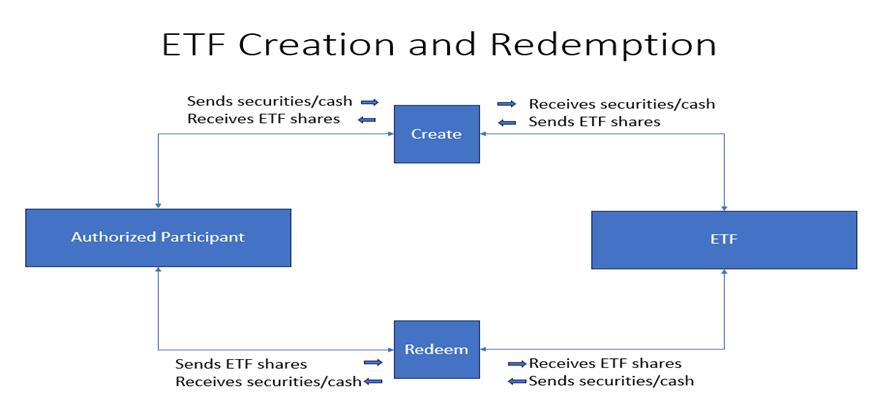
When a market maker sells ETF shares, they enter a T+1 obligation to deliver those shares to the buyer. To fulfill this obligation, they may need to create new ETF shares.
The Standard Creation Process:
- Market maker assembles the basket: They purchase each security in the quantities specified in that day’s standard PCF
- Securities delivered to AP: The market maker delivers the basket securities to the Authorized Participant
- AP transfers to ETF: The AP delivers the securities to the ETF (via DTCC) in exchange for newly created ETF shares
- Shares returned to market maker: The AP delivers the new ETF shares to the market maker, who can now fulfill their T+1 delivery obligation
This in-kind exchange is what enables the tax efficiency ETFs are known for. No sale occurs at the ETF portfolio level, so no capital gain is recognized during the creation process.
Important Note: Any gains on securities that enter the ETF via creation are reflected in the share price of the ETF. These gains will be taxed when ETF shares are eventually sold by investors, not at the fund level.
The Redemption Mechanism
Redemption works in reverse. When market makers are buying ETF shares (due to selling pressure, for example), they redeem shares through the AP.
The AP delivers ETF shares to the ETF and receives basket securities in return. The ETF shares are then destroyed. Securities leave the ETF in-kind, meaning no sale occurs at the portfolio level, and no gain is recognized.
This ability to deliver low-cost-basis securities out of an ETF in-kind via redemption is what preserves tax efficiency. The ETF avoids realizing capital gains that would create taxable distributions to shareholders.
Settlement occurs on T+2 for standard redemptions, compared to T for a typical portfolio sale.
Custom Basket Creation and Redemption: The Portfolio Management Tool
Beyond standard creation and redemption activity driven by secondary market trading, ETF portfolio managers can utilize custom baskets as a strategic rebalancing tool.
Why Use Custom Baskets?
When an ETF holds a position with an unrealized gain, selling that position would trigger a capital gain at the portfolio level, potentially creating a taxable distribution. A custom redemption basket allows the portfolio manager to remove that appreciated position without selling it.
Utilized in both passive rebalances and active management, the process defers the capital gain to the ETF share price (shareholders’ cost basis) rather than realizing it at the fund level.
Coordination with Market Makers
Custom rebalances require advance coordination with the ETF’s Lead Market Maker or DLP. The portfolio manager contacts the market maker to request assistance, balance sheet availability, and willingness. Only the notional amount and number of creation units involved should be disclosed, not the specific security being removed (per compliance requirements).
The Heartbeat Timeline:
Custom rebalances are often referred to as “Heartbeat Trades” as an initial creation causes a spike in AUM for a single day “T”. The whole process occurs over a 48-hour period to demonstrate AP “ownership” of the ETF shares for regulatory purposes.
- T (Trade Date): Market maker creates ETF shares using a standard basket for T+2 settlement
- T+1: Portfolio manager creates and submits a restricted redemption PCF containing only the position(s) being removed. The restricted PCF is published for use only by the market maker’s designated AP. Market maker submits a redemption using the restricted PCF for T+1 settlement
- T+2: Both the standard creation and restricted redemption settle. The position is eliminated from ETF holdings, and capital gains associated with that position are now deferred to the ETF share price
Example: Removing an Appreciated Position
An ETF holds $2.5M of a security with an unrealized capital gain that the portfolio manager wants to defer without triggering a taxable event.
| Timeline | Action | Settlement |
| T | Market maker creates $2.5M of ETF shares using a standard basket | T+2 |
| T+1 | PM submits restricted redemption PCF containing only the $2.5M position. Market maker submits redemption using restricted PCF | T+1 |
| T+2 | Standard creation and restricted redemption both settle. Position removed from ETF, gain deferred to share price | Complete |
Key Consideration: Additional shares of the removed security will enter the ETF through the standard creation basket on T (since it is part of the current holdings). To avoid this, portfolio managers can request a restricted creation PCF with a “cash plug” (Cash in Lieu) for that position, though this depends on the market maker’s willingness to accommodate non-standard baskets and ability to hedge risk.
Regulatory Foundations
SEC Rule 6c-11 permits ETFs to create and redeem in-kind, enabling the tax-efficient structure that differentiates ETFs from mutual funds. The rule standardized ETF operations and removed the need for individual exemptive relief applications.
The DTCC provides settlement guarantees that protect both APs and ETFs during the creation and redemption process, ensuring securities and shares are exchanged as agreed.
For more detailed regulatory information, visit the SEC’s ETF guidance.
The ETF Creation/ Redemption Process Explained: Frequently Asked Questions
How long does the ETF creation/ redemption process typically take?
Standard creations and redemptions settle on T+1 for most U.S. securities. Custom redemptions used for portfolio rebalancing settle on T+1, while the accompanying standard creation settles T+2. This creates the 48-hour timeline for completing a custom rebalance.
What’s the difference between standard and custom baskets?
Standard baskets are published daily and represent a pro rata slice of the ETF’s current holdings. They are used for normal creation and redemption activity driven by secondary market trading. Custom baskets are restricted PCFs created for specific portfolio management purposes, such as removing an appreciated position without realizing a gain. Custom baskets are published for use only by designated APs.
How does in-kind redemption differ from mutual fund redemption?
Mutual fund redemptions require the fund to sell securities to meet redemption requests, potentially realizing capital gains that create taxable distributions for all shareholders. ETF in-kind redemptions transfer securities directly to the AP without selling them, avoiding gain realization at the fund level. This structural difference is why ETFs typically distribute fewer capital gains than mutual funds.
What happens during market stress when underlying securities become illiquid?
Market stress can impair the creation and redemption mechanism when underlying securities are difficult to trade. Market makers may widen spreads or reduce quote sizes, causing ETFs to trade at larger premiums or discounts to NAV. The mechanism typically self-corrects as market conditions stabilize, though the timeline varies based on the severity of the stress and the liquidity of underlying holdings.
Partner with Sound Capital Solutions
Understanding ETF creation/ redemption separates advisors who use ETFs effectively from those who simply own them. At Sound Capital Solutions, we offer consultancy services to help institutional clients build the expertise needed to leverage these structures strategically.
Ready to discuss how the creation and redemption mechanism affects your portfolio management approach? Contact our team to explore how we can support your ETF strategy.